 |
 |
 |
||||||||||||||
|
||||||||||||||
Manned Ornithopters Full History History Archive
Getting Started How to Design & Build Competition Info Design Tools
Design Manual Newsletter Free Plans
Teachers Guide Web Site Links
About the Society Contact Info 
|
|
Ornithopter Stability and Control Getting an ornithopter to fly is only half the battle. For the sake of esthetics, we often depart from the tried-and-true control systems found in airplanes. If we insist on using a flat, triangular tail like a bird, this will increase the challenges of stability and control. Typically, the ornithopter will have a horizontal stabilizer in the back. The tail usually provides a downforce to keep the nose up, and therefore the tail incidence or angle relative to the wing is much more than you would find in an airplane. This angle is typically about 15 degress, but it may be less or more depending on where the center of gravity is located and other aspects of the ornithopter design.
In certain rubber-powered ornithopters, the motor stick has been elongated in an effort to increase duration. With the center of gravity farther to the rear, the stabilizer provides lift instead of downforce, and the incidence is decreased. Obviously, the lifting stabilizer is more efficient, and this is what birds use. However, the more rearward center of gravity location can decrease the directional stability of the ornithopter. Your ornithopter might need a vertical fin. Slight differences between the two wings can cause the ornithopter to turn left or right. If the wing spars are made of wood, their weights will naturally differ. You can also have asymmetry in the mechanical properties of carbon rods, or in the tension of the wing membrane. If the ornithopter wants to turn to one side, this can be corrected by adding weight to the wingtip on the outside of the turn. Through inertia, the added weight acts to supress the flapping motion of the weighted wing, while increasing the flapping amplitude of the unweighted wing. The difference in travel results in a difference in thrust that will compensate for any unexplained pull to one side.
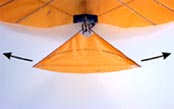
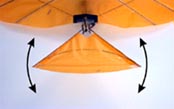
Steering is usually done by the tail. The wings can be used for steering, but this is less consistently successful and more difficult to implement. A simple elevator and rudder system is very effective for ornithopter steering. For a more birdlike appearance, though, a flat, triangular tail is more often used. The tail may swing out to the left and right sides, so that the downforce of the tail causes a rolling moment on the ornithopter. Alternatively, the tail may rotate about its long axis. In this case, the downforce is redirected in a way that provides yaw control. In some RC ornithopters, the tail rotates about an oblique axis, combining the two motions described here.
|
|
|||||||||||