 |
 |
 |
||||||||||||||||||||||||||||||||||||||||||||||||||||
|
||||||||||||||||||||||||||||||||||||||||||||||||||||
Manned Ornithopters Full History History Archive
Getting Started How to Design & Build Competition Info Design Tools
Design Manual Newsletter Free Plans
Teachers Guide Web Site Links
About the Society Contact Info 
|
|
Ornithopter Power Systems Choosing the right motor and battery are both essential for building a successful ornithopter. Here, I will explain some of the different options and how to choose the right power system. How much power is needed, exactly? For typical membrane-winged ornithopters, about 100 watts per kilogram coming out of the motor should be enough power to give your ornithopter a good rate of climb. As ornithopters continue to improve, it should be possible to get by on somewhat less. Estimates of the mechanical power required for bird flight vary over the range of about 10 to 50 watts per kilogram. Rubber Band Power The simplest ornithopters are powered by rubber band. The rubber band combines the functions of motor and battery in one super-convenient package. The rubber band can produce a large amount of torque, so you don't need any gear reduction to flap the wings of your ornithopter. You can simply use a thicker rubber band if you need more power. For all these reasons, rubber-powered ornithopters are by far the easiest to design and build, and definitely the place to start! The grade of rubber is very important. Contest rubber intended specifically for flying models will store several times more energy than standard, office-grade rubber bands. Impressive flight times can be achieved in lightweight models. Roy White holds the record for indoor, rubber-powered ornithopters at 21 minutes, 44 seconds! Electric Motors Most radio-controlled ornithopters are powered by an electric motor and battery. There are several types of electric motor that may be used in an ornithopter. The selection of motor type will depend on your specific project.
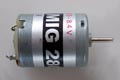
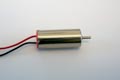
The standard brushed motor is the oldest type and the most familiar to most people. These motors have a central, rotating shaft called the "armature". The armature has coils of wire that serve as electromagnets to make the armature rotate. They act against permanent magnets in the motor casing. Electrically conductive "brushes" transfer power to the rotating shaft. The electrical contacts are designed so that, as the armature rotates, the electromagnets are switched on and off in a specific sequence, which allows continuous rotation. Brushed motors are the least expensive type, and a properly selected brushed motor will supply enough power for most ornithopter needs. It is important to realize that the amount of power depends more on the windings rather than the size of the motor. Two identical-looking motors can have completely different performance. Therefore you must buy a good motor that is intended for model aircraft, rather than trying to use random motors that you take out of some toy.
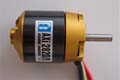
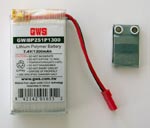
In a "brushless" type motor, the electromagnets are switched on and off electronically, so there are no mechanical contacts. This is more efficient, but it requires a special electronic device called a brushless motor controller. This makes them more expensive than brushed motors. For ornithopters, you want to use the "outrunner" type of brushless motor. These motors have an outer casing that rotates, while the inner electromagnets remain stationary. Outrunners tend to operate at a lower speed and higher torque compared with other motors. For that reason, they don't need as much gear reduction. However, if you have an ornithopter that was already designed for a high-RPM motor, you might consider using one of the regular "inrunner" type brushless motors. Whatever type of motor you use, there is an optimal way of loading the motor. If you make the wings bigger, the motor will run slower. If you make the wings smaller, the motor will run faster. You will get the greatest motor efficiency if you adjust the size of the wings so that the motor is running at about 80% of the speed that it would turn with no load. You can run the motor at lower speeds to get more power, but then it becomes less efficient. At about 60% of the free RPM, the motor is at its maximum power output, and below that, you are just going to burn out the motor. You may not want to change the size of the wings, in which case you can adjust the gear ratio or flapping amplitude instead. Batteries The battery is just as important as the motor for determining power output. There are several types of battery on the market. You will probably use some type of rechargeable lithium battery in your ornithopter. The most common are lithium-polymer batteries, abbreviated "Li-poly". These are in the form of rectangular foil packs, and they produce 3.7 volts per cell. They are the same batteries used in portable electronic devices. Another option is the A123 or "lithium iron phosphate" technology. These batteries are safer and have a higher power output than Li-poly batteries. Regardless of which type you choose, it is important to use the correct type of charger for your particular battery. Birds use their body fat to store energy for flight. It contains seventy times more energy, for its weight, than our best batteries. That is the main reason why birds can make long distance flights, whereas battery-powered ornithopters or model airplanes typically fly for half an hour or less.
Internal Combustion Internal combustion engines have been used in ornithopters. Normally, a pull-start engine equipped with a centrifugal clutch and a large heat-sink would be used, similar to what would be found in an RC helicopter or car. Despite the high energy density of the fuels, internal combustion engines are far less efficient than electric motors. Combined with the difficulties of starting, cooling, exhaust, and noise, this weighs against the use of internal combustion engines in most ornithopters. They should be considered for manned ornithopters, or in special applications where the required flight duration cannot be achieved using batteries.
|
|
|||||||||||||||||||||||||||||||||||||||||||||||||