 |
 |
 |
||||||||||||||||||||||||||||||
|
||||||||||||||||||||||||||||||
Manned Ornithopters Full History History Archive
Getting Started How to Design & Build Competition Info Design Tools
Design Manual Newsletter Free Plans
Teachers Guide Web Site Links
About the Society Contact Info 
|
|
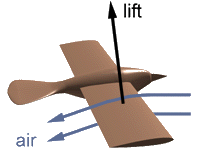
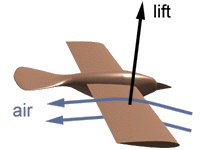
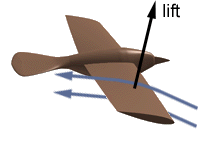
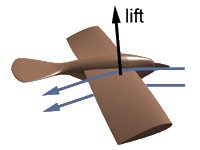
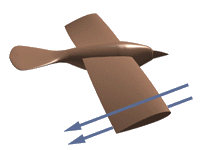
How Birds & Ornithopters Fly You may be surprised to learn that a bird or ornithopter flies in much the same way as an airplane. The wings produce lift in the same way as an airplane, simply by their forward motion through the air. To understand how this works, let's start with the simple case of gliding flight. Gliding Flight When a bird is just gliding, it moves forward through the air, with its wings held in a fixed position. The wings are at a slight angle, so they deflect the air gently downward. Pushing the air downward causes a reaction force in the opposite direction. You will notice a reaction force, any time you push against anything! The reaction force is called lift. Lift is a force that acts roughly perpendicular to the wing surface and keeps the bird from falling.
There is also air resistance or drag on the body and wings of the bird. This force would eventually cause the bird to slow down, and then it wouldn't have enough speed to fly. To make up for this, the bird can lean forward a little and go into a shallow dive. That way, the lift force produced by the wings is angled forward slightly and helps the bird speed up. Really what the bird is doing here is giving up some height in exchange for increased speed.The bird must always lose altitude, relative to the surrounding air, if it is to maintain the forward speed that it needs to keep flying.
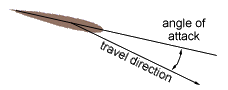
Angle of Attack Recall that the wings are angled slightly, which allows them to deflect the air downward and produce lift. The slight angle of the wings is called the angle of attack. If the angle of attack is too great, the wing will produce a lot of drag. If the angle is too small, the wing won't produce enough lift. The best angle depends on the shape of the wing, but it's usually just a few degrees! Notice that what matters is the angle relative to the direction of travel, not relative to the horizon.
The ornithopter wing usually consists of a thin fabric membrane, which takes on a curved or cambered shape, when it pushes against the air. Birds have more of a rounded leading edge to help reduce air resistance. The inner part of the wing, near the bird's body, is more curved than the outer part. As you read on, see if you can figure out why! Flapping-Wing Flight Flapping wings work on the same principle as an airplane propeller, except they are moving back and forth. The wings flap with an up-and-down motion, usually. But as the wings move up and down, they are also moving forward through the air along with the rest of the bird. Close to the body, there is very little up and down movement. Farther out toward the wingtips, there is much more vertical motion. As the bird is flapping along, it needs to make sure it has the correct angle of attack all along its wingspan. Since the outer part of the wing moves up and down more steeply than the inner part, the wing has to twist, so that each part of the wing can maintain just the right angle of attack. The wings are flexible, so they twist automatically. This picture shows how the wing must twist in the downstroke, to keep each part of the wing aligned with the local direction of travel. Airplane propellers also have a twisted shape, but their continual rotation means the shape doesn't have to change.
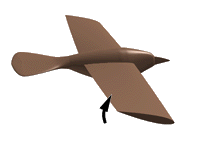
As the wing moves downward and twists, the lift force in the outer part of the wing is angled forward. This is what would happen if the whole bird went into a steep dive. However, only the wing is moving downward, not the whole bird. Therefore the bird can generate a large amount of forward propulsive force or thrust, without any loss of altitude.
The air is not only deflected downward, but also to the rear. The air is forced backward just as it would be by the propeller of an airplane. You can feel this blast of air when a bird takes off from your hand. If thrust is produced in the downstroke, you might be wondering what happens in the upstroke. Often people have the wrong-headed notion that the upstroke will somehow cancel out the downstroke. But remember, the force produced depends on the angle of attack. It can be controlled. And here is what birds do to make the upstroke more efficient:
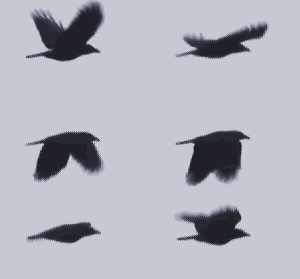
The inner part of the wing is different from the outer part. There is little up-and-down movement there, so that part of the wing continues to provide lift just as a result of its forward motion. Only the inner part of the wing produces lift in the upstroke, so the upstroke as a whole offers less lift than the downstroke. As a result, the bird's body will bob up and down slightly as the bird flies.
So, like an airplane, lift and thrust functions are separated. The outer part of the wing provides thrust. The inner part of the wing produces lift. What you've read so far is a basic description of how birds fly, when they are already up to speed and just cruising along. Birds also have other flying techniques, which they use when taking off or landing, or for other special maneuvers. Books on bird flight will tell you more about these techniques as well as the special adaptations birds have for flight. Bird Flight Myths Q: Doesn't
a bird push its wings backward against the air? Q: Doesn't
a bird separate its feathers during the upstroke? Q: Do birds
move their wings in a figure-8 motion?
|
|
|||||||||||||||||||||||||||