 |
 |
 |
||||||||||||||
|
||||||||||||||
Introduction Teachers Guide
Insects Birds Bats Pterosaurs Fish Wing Structures
Gliding Soaring Flapping Migration
Seed Helicopter Build a Bird
Ornithopter Zone Web Site Links  |
|
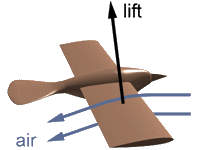
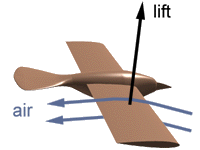
Gliding Flight in Birds When a bird is gliding, it doesn't have to do any work. But it can't stay in the air forever! The wings are held out to the side of the body and do not flap. As the wings move through the air, they are held at a slight angle, which deflects the air gently downward. Pushing the air downward causes a reaction force in the opposite direction. You will notice a reaction force, any time you push against anything! The reaction force is called lift. Lift is a force that acts roughly perpendicular to the wing surface and keeps the bird from falling.
There is also air resistance or drag on the body and wings of the bird. This force would eventually cause the bird to slow down, and then it wouldn't have enough speed to fly. To make up for this, the bird can lean forward a little and go into a shallow dive. That way, the lift force produced by the wings is angled forward slightly and helps the bird speed up. Really what the bird is doing here is giving up some height in exchange for increased speed. (To put it another way, it is converting its gravitational potential energy into kinetic energy.) The bird must always lose altitude, relative to the surrounding air, if it is to maintain the forward speed that it needs to keep flying.
Many different groups of animals have evolved the capacity for gliding flight. There are lizards, fish, snakes, squirrels, and opossums that can glide. There is even a gliding primate-like mammal called the flying lemur. Some additional gliding creatures are known from the fossil record. But relatively few groups have actually crossed over into the realm of powered, flapping-wing flight. Some of the gliding groups have obvious anotomical limitations that would prevent further evolution. Next, read about soaring flight. .
. |
|
|||||||||||